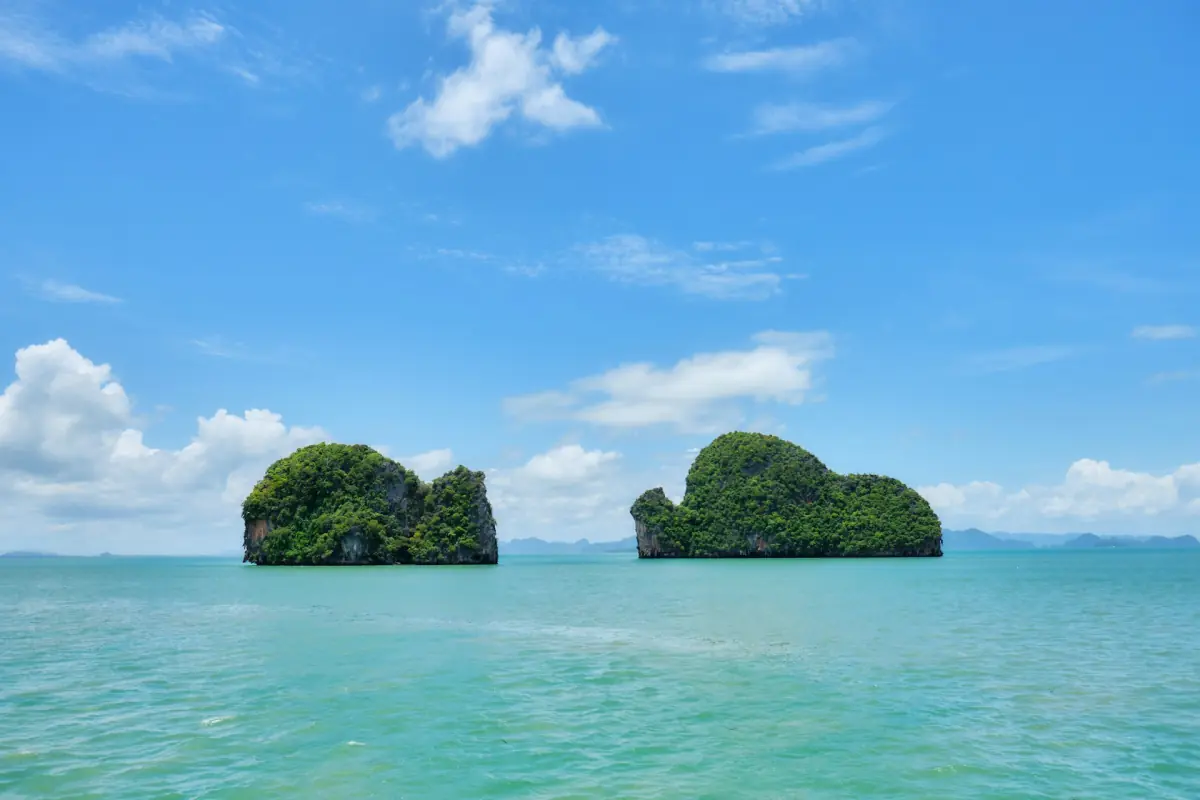
Phang Nga Bay weather by month
If you are asking when to go, the short answer is that the drier months from December to March give the calmest and most predictable days for a boat trip. The best time to visit Phang Nga Bay is still a question of risk rather than a fixed window: the bay is a shallow, sheltered stretch of water between Phuket and Krabi, yet it sits on the Andaman coast and feels the same seasons as the rest of it.
The table below shows long-term averages for 1991 to 2020 from the Phuket station of the Thai Meteorological Department. It was not measured in the bay itself and it is not a forecast. Treat it as a guide to the pattern of the year, then check the actual weather before the day you travel.
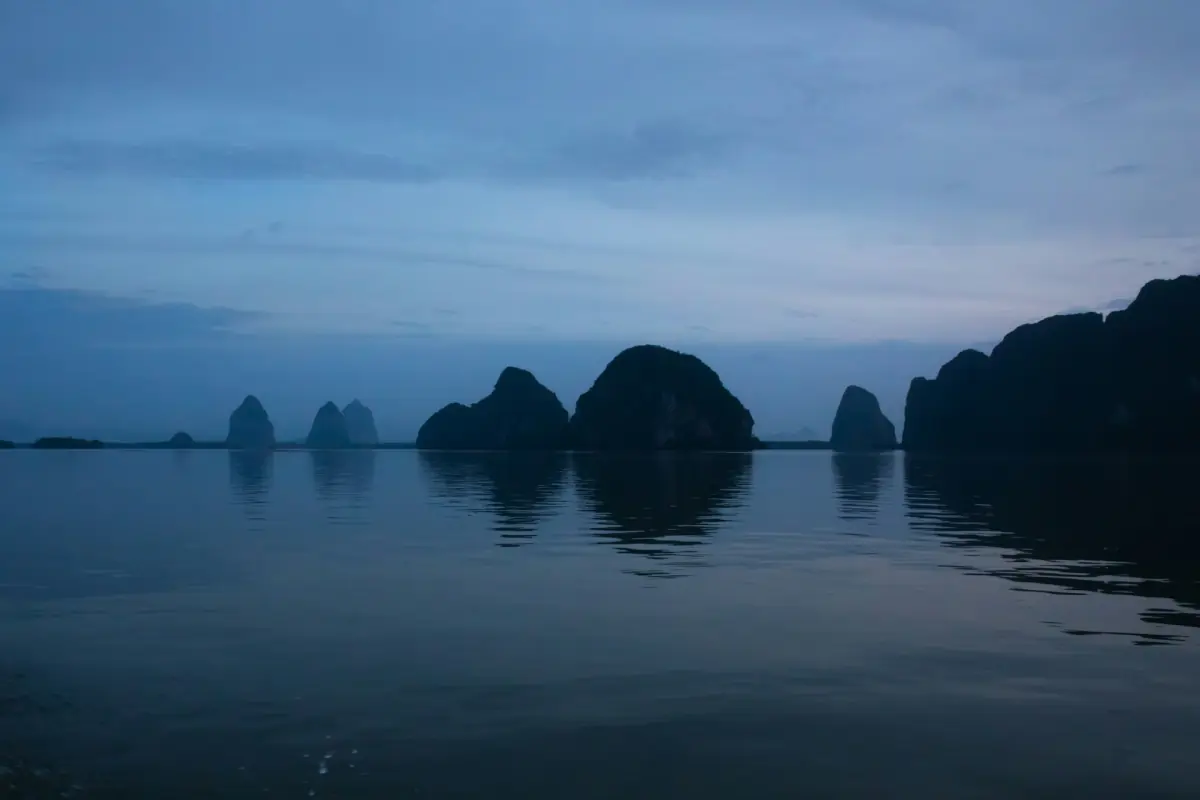
Monthly averages, 1991 to 2020
Mean daily highs and lows in degrees Celsius and mean monthly rainfall in millimetres, Phuket station.
| Month | Max °C | Min °C | Rain mm |
|---|---|---|---|
| January | 33.0 | 25.0 | 49.9 |
| February | 34.0 | 25.4 | 24.0 |
| March | 34.4 | 25.9 | 80.7 |
| April | 34.2 | 26.3 | 135.1 |
| May | 33.2 | 26.1 | 236.9 |
| June | 32.6 | 25.8 | 249.4 |
| July | 32.3 | 25.6 | 240.2 |
| August | 32.2 | 25.6 | 308.7 |
| September | 31.8 | 25.1 | 350.4 |
| October | 31.8 | 24.9 | 336.0 |
| November | 32.1 | 25.2 | 178.2 |
| December | 32.1 | 25.0 | 82.0 |
Temperatures hardly change through the months; it is warm on the water every day. What separates the seasons is rain and sea state, which is why the rainfall column matters most when you pick a date.
Our take: an evening trip
This big boat trip with canoes and a Thai dinner runs into the evening. It suits the drier months from December to March best, and the sea can still change, so keep your plans flexible.
Hand-picked tours, booked through Viator. Prices are indicative starting prices in US dollars (as of October 2026). Tap a tour for live availability and the current price in your currency.
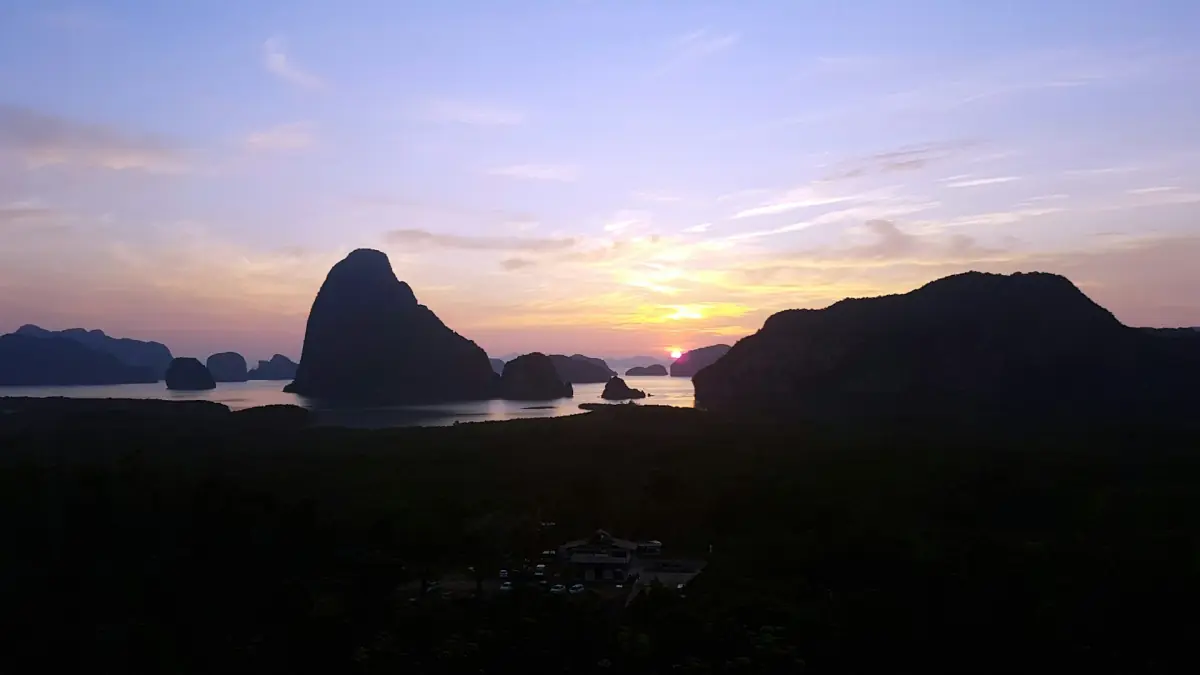
Phang Nga Bay tours and day trips
Boat tours of the bay with hotel pickup, canoe stops and the park fee shown in each option's inclusions.
December to March
These are the months most visitors aim for. Rainfall in the long-term averages is clearly lower than in the middle of the year, February is the driest month of the series, and the sea tends to be calmer. If you are thinking about Phang Nga Bay in December, you are planning for the start of this drier stretch, which also brings the largest numbers of boats and visitors to the popular stops.
The dry months suit an unhurried evening cruise. A big-boat trip with canoes, paddlers and dinner, running from the afternoon into the evening, fits this part of the year well because the weather is usually settled for the whole outing. Return times depend on the operator, so confirm them when you book.
Even in the drier months a single day can bring cloud or a shower, so the trip is not guaranteed to be clear. If your plans are fixed, leave a spare day in your schedule rather than counting on one particular date.
Southwest monsoon from May to October
The southwest monsoon brings rougher seas from about May to October, and boats can be cancelled on bad days. In the narrow passages between the islands, currents can also be stronger. This is the period when the rainfall figures in the table are highest, with September the wettest month of the series.
That does not mean every outing is lost. It means the decision is made day by day. Check the forecast and your operator's notice before you go, and be ready to move the trip to another day if the boats do not leave.
As an example of how quickly conditions can change, a flood and flash flood warning was issued for 26 to 29 October 2026 for the area around Ko Yao, Takua Thung, Mueang Phang Nga, Phuket and Krabi. That period has passed, but it shows why warnings on the day of travel deserve a look. Announcements from the park and the pier, and a confirmation from your operator, tell you more than any seasonal rule.
Tides and the hongs
The tide matters as much as the season for the canoe part of a trip. A hong is a room inside a limestone island that you reach through a cave at the right water level, and the route in and out depends on how high the water stands. The Royal Thai Navy publishes tide tables for 2026, and they are a useful background for understanding why trips run at different hours.
A table is not a passage plan, though. Guides read the water on the spot and decide whether a particular hong can be entered. No time of day or tide state opens every hong, so accept that the route can change and let your guide choose. You can read more about the paddling side on the kayaking page.
Best time to visit James Bond Island
The best time to visit James Bond Island follows the same logic as the rest of the bay. Calm weather makes landing on Khao Phing Kan easier and the boat ride more comfortable, while Ko Tapu, the needle rock beside it, is seen from the shore or from the boat. Some programmes start later in the day to avoid the groups that arrive in the morning. Read more on the James Bond Island page.
The park fee for foreign visitors is 300 THB for adults and about 100 to 150 THB for children; check the current rate with your operator. Details are on the national park page.
Planning around the weather
Choose a flexible date
Book the tour for a day when you have a spare day behind it, especially from May to October. Ask how your operator handles a cancelled departure.
Check the day before
Look at the forecast and at any warnings for Phuket, Phang Nga and Krabi. Your operator will tell you if the pier is not sailing.
Pick your departure
Boats leave from Phuket, Krabi and Khao Lak. See tours from Phuket and tours from Krabi, and use the where to stay page to choose a base.
Best time to visit Phang Nga Bay: frequently asked questions
What is the best month to visit Phang Nga Bay?
The long-term averages point to the drier months from December to March, with February the driest month of the series. Conditions on any given day still depend on the weather and the sea.
Can I visit Phang Nga Bay in the rainy season?
Operators list tours in many months, but the southwest monsoon brings rougher seas from about May to October and boats can be cancelled on bad days. Check the forecast and your operator's notice before you go.
Are the temperatures in the table measured in the bay?
No. They are long-term averages for 1991 to 2020 from the Phuket station of the Thai Meteorological Department and are not a forecast.
Does the tide decide whether I can enter a hong?
Yes, water level plays a large part. Guides decide on the spot, so no fixed time or tide state can be promised for every hong.
Is this the official website of the park or the tourism authority?
No. This site is independent and is not the official website of Thailand's national park authority, Ao Phang Nga National Park, the Tourism Authority of Thailand or Phang Nga province.