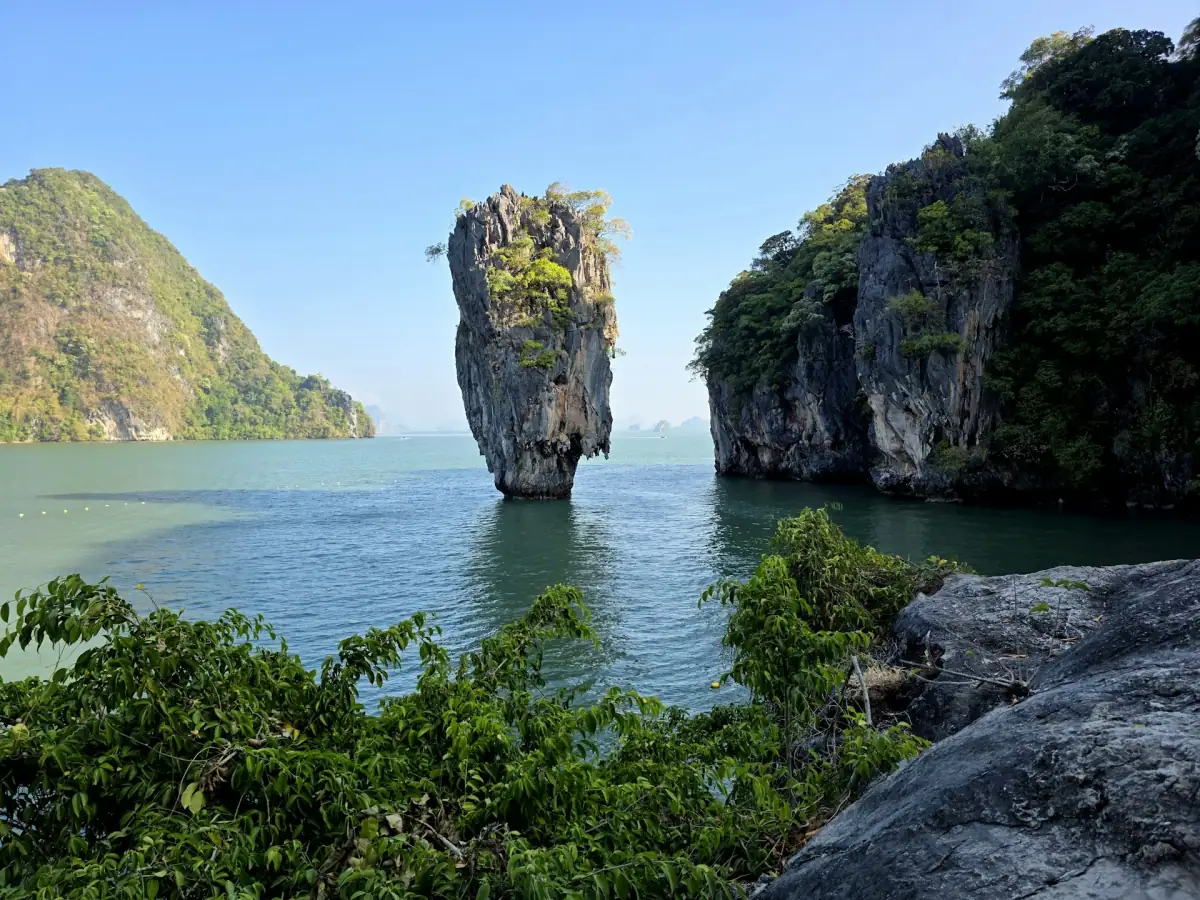
The Man with the Golden Gun (1974)
Most people first hear about the bay through a film. The rock known today as James Bond Island, Ko Tapu, became famous after it appeared in The Man with the Golden Gun, released in 1974. The slender limestone pillar, about 20 m high and narrower at its base than at the top, stood in for the hideout of the villain, and the name James Bond Island has stuck ever since. Locals and maps use Ko Tapu, and guides on the boats use both names.
Phang Nga Bay history is often told through this one scene, but the film only drew a global audience to a landscape that already existed. The pillar stands about 40 m from the larger island of Khao Phing Kan, where visitors land today. If you want to see it for yourself, the James Bond Island page explains how a visit works and what to expect on the day. The question of how James Bond Island history became a tourism story is simple: a film, then boats, then a park.

Our take: a tour to the places in this story
This speedboat tour with a guide leads to James Bond Island and Koh Panyee, the two places this page is about.
Hand-picked tours, booked through Viator. Prices are indicative starting prices in US dollars (as of October 2026). Tap a tour for live availability and the current price in your currency.

See the places in this story
A guided speedboat trip to James Bond Island and Koh Panyee, the two places behind most of the bay's history.
Koh Panyee's Javanese founders
A village on stilts with a history older than the film.
Long before the film crew arrived, people were already living in the bay. Koh Panyee, also spelled Ko Panyi, is a Muslim fishing village with houses on stilts above the water. The Thailand tourism authority traces the community back to three Javanese families who arrived from Indonesia at the end of the 18th century. Their descendants are still the community today.
The village is not a floating one in the strict sense. The houses stand on posts, and the walkways connect them to a rock that rises from the water. Fishing, food and souvenirs are part of daily life, and there is a school and a health centre. Roughly 200 houses are mentioned in descriptions, but that is only an approximate picture of the settlement. For a visitor guide, see the Koh Panyee page, which also explains how to be a respectful guest.
Panyee FC (1986)
The football story behind the floating pitch.
The best known modern chapter of the village is football. In 1986 the men's football World Cup inspired young people on Koh Panyee to start playing, but there was no flat land for a pitch. They built one themselves from old wood and other material they could find, and Panyee FC grew out of that idea. The tale is often retold because it shows how a small community solved a practical problem with what it had.
This is a story about the past. It does not mean visitors can play on the pitch or that it opens at fixed times. Treat the village as a place where people live, not as a sports venue.
National park since 1981 and Ramsar site since 2002
From landscape to protected area.
The bay was established as a national park in 1981 and covers about 400 km². It protects steep limestone islands, caves, mangroves, tidal flats and seagrass. In 2002 the bay was also listed as a wetland of international importance under the Ramsar Convention, with the designation dated 14 August 2002. These two dates are the main protection milestones in the story.
The park shapes what you see today: a fee at the gate, rules about sunscreen and rubbish, and boats that keep their distance from the fragile rock. The national park page lists the fee, the e-ticket news and the rules.
Late 18th century
Three Javanese families settle at Koh Panyee.
1974
The Bond film puts Ko Tapu on the world map.
1981
The bay becomes a national park.
1986
The World Cup inspires Panyee FC.
2002
The bay is designated a Ramsar wetland.
How the landscape formed
The islands are limestone mountains that the sea flooded, leaving steep towers, overhangs and caves. Over time, waves and tides carved hongs, the hidden lagoons that sea canoes visit. This geology is the reason the bay looks the way it does, and why a short boat ride shows you so much variety. For the canoe side of the story, read about kayaking in the hongs.
This page does not attempt a complete regional chronicle. It sticks to the dates and events that visitors meet on a tour, and each one points to a place you can see.
Phang Nga Bay history: frequently asked questions
Why is it called James Bond Island?
The rock Ko Tapu appeared in the 1974 film The Man with the Golden Gun, and the nickname stayed.
Who founded Koh Panyee?
The community traces its origin to three Javanese families who arrived at the end of the 18th century.
When did Panyee FC start?
The idea came from the 1986 World Cup, when local youths built a pitch from old wood.
When did the bay become a national park?
In 1981. It was designated a Ramsar wetland on 14 August 2002.